

Mukesh Khanna Takes Aim At Sharmila Tagore Over Vande Mataram Debate: ‘You Became Ayesha Begum For Marriage’
Mukesh Khanna has taken on veteran actress Sharmila Tagore over her comments which she made about the national song ‘Vande Mataram’. The actor, known for playing Bhishma in *Mahabharat* and superhero Shaktimaan, said religious sentiment should control which parts of the song are performed.
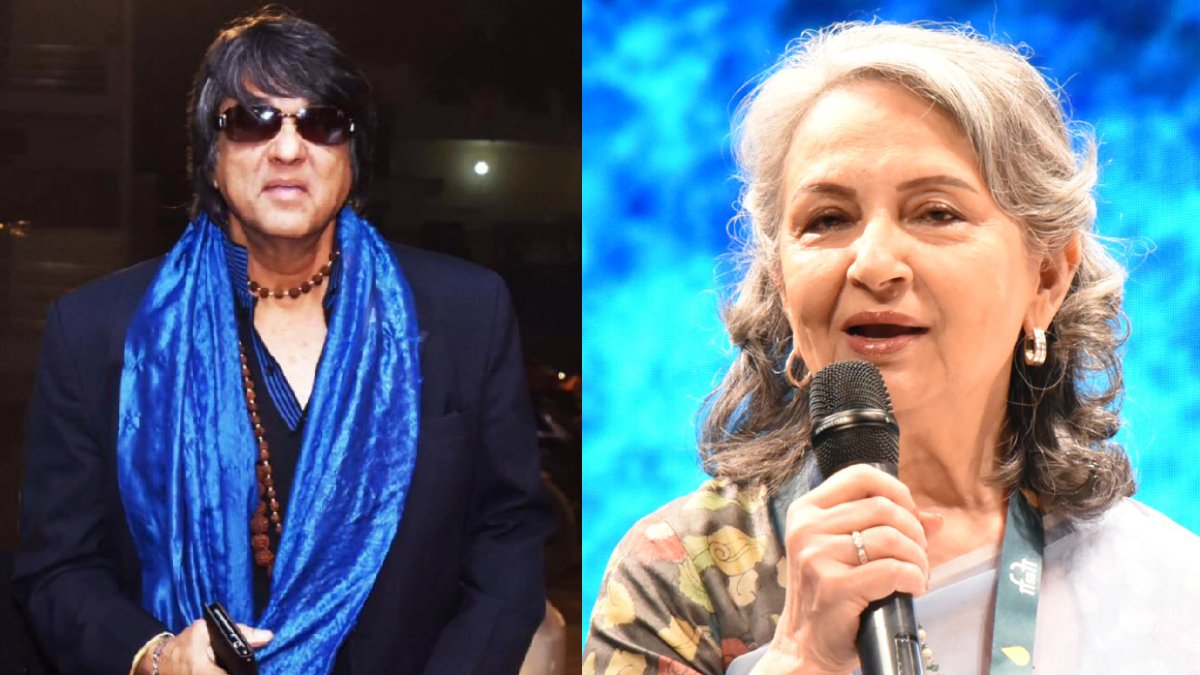
Mukesh Khanna was asked by *The Free Press Journal* about Sharmila Tagore’s position that only the opening stanzas of “Vande Mataram” should be sung, considering India’s religious diversity and the sentiments of different communities. Khanna disagreed with the view and asked why concerns about religion should play a role in discussions about the national song.
Mukesh Khanna Questions Sharmila Tagore’s Position
Sharmila Tagore was entitled to her own interpretation, Mukesh Khanna questioned what was in her reported remarks. He felt that her position appeared to be based on concern about whether people belonging to other religions would accept certain parts of the song.
Khanna then made a pointed reference to Sharmila Tagore’s marriage into the Pataudi family. He referred to her as “Ayesha Begum” and questioned whether she had only come to know of religious differences after marriage.
“Did you realise only after marriage that Islam also exists?” Khanna was quoted as saying. He also wondered why Sharmila, who grew up in a Hindu culture, was now worried about how other communities might see *Vande Mataram*.
Sharmila’s Bengali background was also brought up by the actor. He pointed out the cultural traditions that she had to face growing up in Bengal, including Kali Puja and wondered why religious sensitivities were at the heart of the current debate.
Mukesh Khanna Shares His Interpretation Of Hinduism
Mukesh Khanna also spoke about his understanding of Hinduism and the concept of different deities. And many gods and goddesses in Hinduism don't mean that Hindus believe in many Gods.
Khanna notes that there is one formless or “nirakar” God and that devotees can see that divine presence in many forms. He gave examples of figures like Hanuman, Shiva, Ram and Krishna that devotees can associate with the divine.
He explained that an individual devotee might see God in the form that he or she wishes to be. In his view, these different manifestations do not contradict the idea of one supreme divine presence.
‘Vande Mataram’ And The Question Of Religious Sentiments
Khanna also addressed objections that have been raised around “Vande Mataram”. He claimed that opposition from parts of the Muslim community was not a new development and some objections were linked with the idea that Muslims should bow only before Allah.
The actor referred to some popular versions of *Vande Mataram* as well as famous songs sung by Lata Mangeshkar and Hemant Kumar among others in the past. He also mentioned AR Rahman’s popular patriotic song *Maa Tujhe Salaam* for example.
Khanna noted that the phrase “Maa Tujhe Salaam” refers to the nation as a mother and suggested that saluting the motherland should not automatically be read as a religious act.
‘We Are Not Forcing Anyone To Bow’
Mukesh Khanna also argued that nobody should be required to bow before an image or symbol of Bharat Mata. But he wondered why that personal choice should extend to opposition against singing *Vande Mataram* itself.
“We bow before Bharat Mata. If someone does not want to bow, fine, we are not forcing them to bow,” Khanna said, while also questioning objections to singing the national song.
His comments come as there is a revived public discussion on *Vande Mataram*, its historical significance as well as how national symbols should be seen to be approached in a religiously diverse country. The song was composed by Bankim Chandra Chattopadhyay and has long been the cornerstone of India’s freedom movement and culture.
Mukesh Khanna Accuses Political Parties Of Appeasement
Khanna’s final line of criticism was directed at political parties that, according to him, have approached the controversy through electoral politics. Some parties even take positions on religious and cultural issues to gain political support, he said, and that is why some are so inclined to take positions on religious and cultural issues in order to maintain their political support.
“You are not following a principle; you are following appeasement,” Khanna explained, saying political calculations should not determine discussions around national symbols.
The remarks have given another voice to the ongoing debate around “Vande Mataram.” Sharmila Tagore’s comments have been reported as being in favor of the idea of accommodating India’s religious diversity, but Khanna argues that respect for different faiths should not require changing the way the national song is approached. And his biting criticism of Tagore’s marriage and religious identity - especially of Tagore’s marriage and religion - will also have to be a hot topic of discussion and reaction in social media and the entertainment industry.


 Latest Movies Trailer





Comments
Please to leave a comment on this article.