
James Cameron’s Titanic is still one of the most technically ambitious movies you have ever seen and the flooding scenes are a huge reason why.
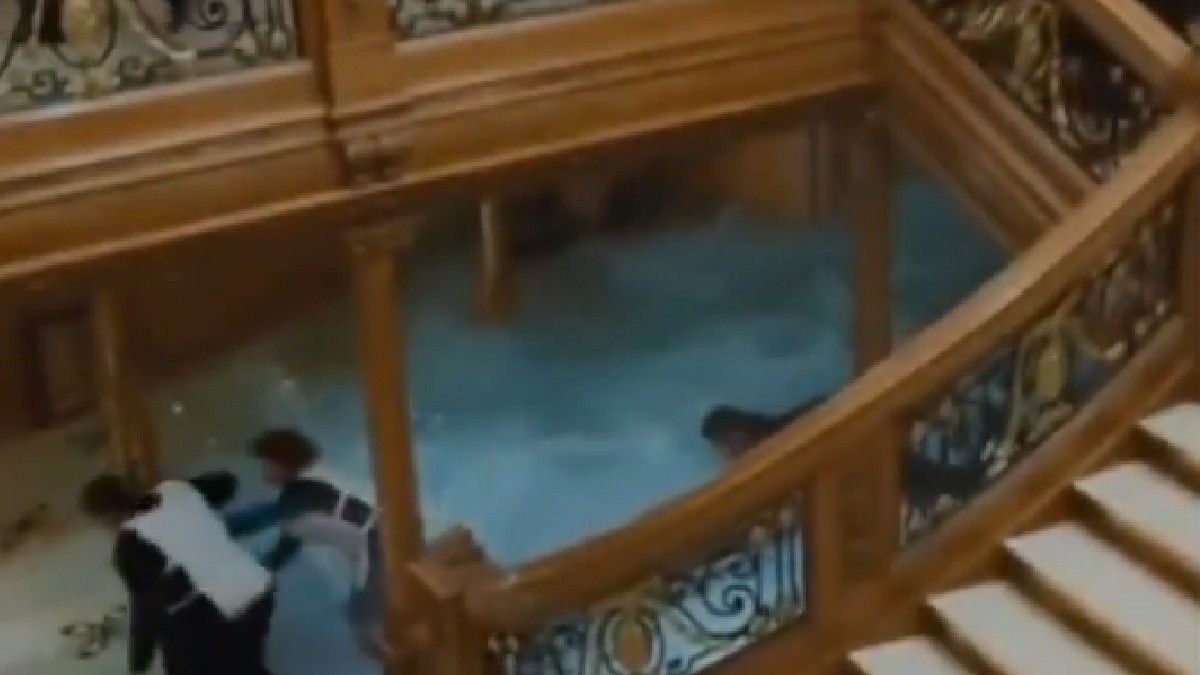
While today’s audience may think the ship has been destroyed primarily with computer graphics, much of what we see on screen was done with large sets and water and carefully planned stunts as well.
Cameron used a huge water tank in Mexico and built large sections of the Titanic to recreate the ship’s last hours. Rather than just relying on digital effects, the filmmakers flooded and damaged sets to create as realistic a disaster as possible.
The Grand Staircase was destroyed in one of the most memorable scenes. The ocean was violently breaking into the ship’s interior and water was poured into the set.
The filmmakers needed to keep the pressure, water flow and movement of the set in check and cameras were on the scene.
The production also employed a rather unusual technique for some corridor sequences. Rather than simply let water rise around the actors, sections of the set were manipulated and lowered into water.
This gave Cameron more control over the movement of water and created the illusion of flooding around Jack and Rose.
There were serious challenges in the physical approach. Working with huge amounts of water, heavy sets and performers brought risks that had to be carefully managed.
Kate Winslet has also spoken about how difficult the water sequences were to film, including the cold temperatures.
The reason Titanic's flooding looks impossible to replicate today is because insurance companies won't allow it anymore.
— P.S. I Love ME (@ps_ilove_me) August 18, 2026
James Cameron built a 17-million-gallon water tank on the coast of Mexico, constructed a near-full-scale Titanic inside it, and then destroyed it on purpose… pic.twitter.com/BvvQnR6AnM
What makes Titanic so impressive today is the scale of the real filmmaking.
Modern studios have sophisticated CGI, virtual production and digital water simulations that can produce spectacular disasters without flooding enormous sets or exposing actors and crews to the same physical conditions.
That doesn’t mean that real effects are gone. Filmmakers still use real sets, miniatures, water tanks and physical effects when they provide a visual quality that computers struggle to reproduce perfectly. Yet Cameron’s approach to Titanic was extraordinary.
The film proved both the power and the cost of real filming. It required so much engineering, planning and production resources to get the flooding scenes done that it still seems quite convincing decades later.
For people watching Titanic today, the spectacle is more than a special effect.
It is a reminder of the era when filmmakers were willing to build huge physical environments and pour real water into them in order to capture images that could not be made in any other way.














Comments
Please to leave a comment on this article.